
Hiring a SaaS design agency is not always the right move. Done at the wrong time, for the wrong reasons, it produces expensive outputs that the team cannot maintain, misaligned deliverables that do not reflect how the product actually works, and a design system that gets abandoned six months after the engagement ends.
Done at the right time, it is one of the highest-leverage investments a SaaS product team can make — compressing years of design iteration into weeks, delivering a level of craft and strategic thinking that is genuinely difficult to hire full-time at early and mid-stage, and creating a product surface that consistently converts and retains better.
The difference between the two outcomes comes down to timing, brief clarity, and understanding what an agency can and cannot do.
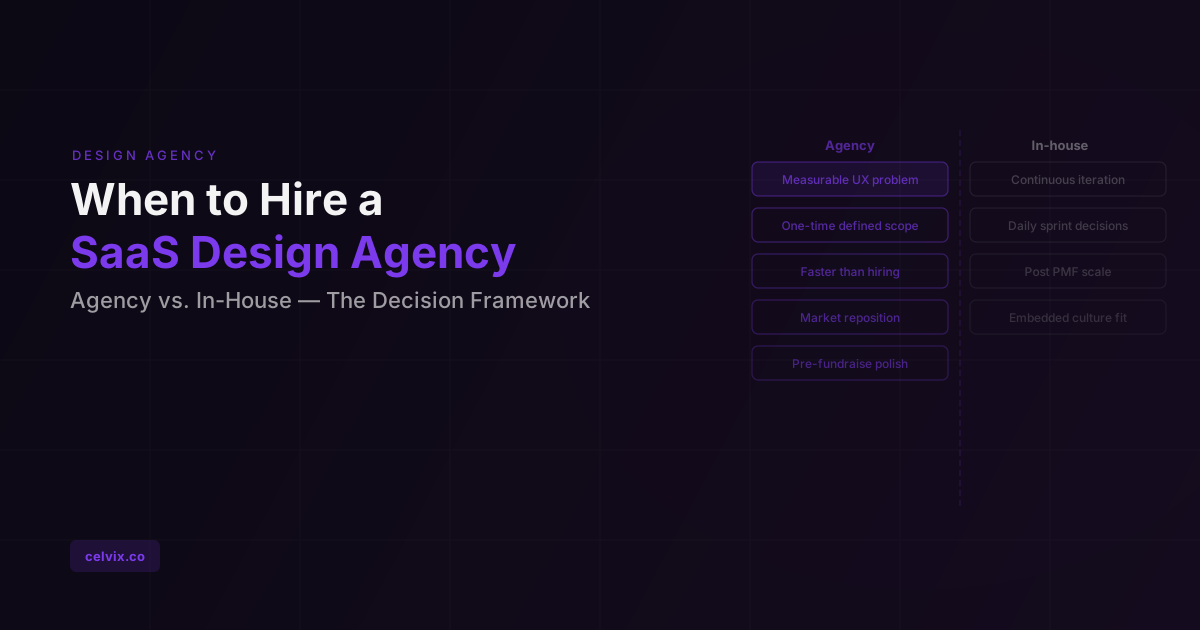
TL;DR: Hire a SaaS design agency when you have a measurable UX problem you cannot fix internally, a defined one-time scope, a need to move faster than a hire allows, or a repositioning for a new market or pricing tier. Do not hire one before you have validated the core product, when the brief is vague, or when what you actually need is a designer embedded in daily product decisions.
Signals That You Should Hire a SaaS Design Agency
Your product has a UX problem you can measure but cannot fix internally
Activation below 30%. High trial-to-paid intent but poor conversion. Users completing signup but never reaching the core workflow. These are design problems. If your team has looked at the data, identified the friction points, and tried internal fixes without moving the metric, external design expertise is likely the fastest path to improvement.
Agencies that work exclusively on SaaS products have pattern-matched across dozens of activation, onboarding, and retention problems. They will often identify the root cause in the first week of engagement — not because they are smarter than your team, but because they have seen the same failure mode in other products.
You are redesigning a product for a new market or pricing tier
Moving a product upmarket, repositioning it for enterprise buyers, or overhauling the pricing model almost always requires a design overhaul. The visual language, the density of information, the presence or absence of social proof, the trust signals in the checkout and onboarding flow — all of these shift significantly when the audience changes.
This is a high-stakes design project with a clear business outcome. It is a good use of agency expertise.
You need to move faster than your current team can
Hiring a full-time senior SaaS designer takes three to four months, costs £80,000–£140,000 per year in total compensation, and requires a runway that most early-stage companies are not comfortable with before product-market fit.
An agency can start in two to four weeks and deliver a focused scope of work — a redesigned onboarding flow, a design system, a new service page — in six to twelve weeks. If the business has a specific milestone tied to the design work (a fundraise, a launch, a sales push), the agency model often makes more sense than a hire.
You have a one-time design challenge with a defined scope
A brand identity, a design system, a complete UI overhaul, a new marketing site — these are discrete projects with a defined start, end, and deliverable. They are well-suited to agency engagements.
Ongoing product iteration, where the team needs to react to user research and ship weekly, is less well-suited to an agency model unless the engagement is structured as a retainer with embedded designers.
Your design work consistently loses to competitors
If you are in competitive sales conversations and design quality is coming up as a reason you are not winning, that is a market signal worth listening to. B2B SaaS buyers increasingly use design quality as a proxy for product quality and company maturity. A product that looks like a v0.1 will lose deals to a well-designed competitor at a similar price point.
Signals That You Should Not Hire a SaaS Design Agency
You have not validated the core product yet
Investing in design polish before you have product-market fit is one of the most common early-stage mistakes. If you do not know whether users value the core workflow, a well-designed version of that workflow is not going to solve the fundamental uncertainty.
Get product-market fit signals first. Learn what users actually do in the product. Then invest in design that makes the validated experience better.
The design brief is vague
“Make the product look more modern” is not a brief. “Redesign the onboarding to improve 7-day activation from 18% to 30%” is a brief. Agencies do their best work — and produce outputs that your team can actually use — when the problem is specific and the success metric is defined.
If you cannot write a brief with a clear problem statement, a target outcome, and the constraints the agency needs to work within, the engagement will drift. That is expensive.
You need someone embedded in daily product decisions
Agencies work on defined scopes. If what you actually need is a designer in your Slack, in your sprint planning, reviewing every feature before it ships — you need a hire, not an agency. Trying to use an agency as a substitute for an in-house designer creates frustrating dynamics on both sides.
You want to outsource the hard product thinking
A design agency should accelerate and deepen your product thinking, not replace it. If you do not have a point of view on what users are struggling with, what the product should prioritise, and what success looks like — an agency cannot manufacture that for you. The best engagements are collaborative. The inputs you bring to the table determine the quality of what comes out.
What to Look For in a SaaS Design Agency
SaaS-specific experience. A brand agency, a web design studio, or a product design generalist will approach a SaaS UX problem differently than a team that works exclusively on SaaS products. Look for case studies that reflect the specific kind of problem you are trying to solve — not just visual quality.
A defined process for discovery. Good agencies do not start designing immediately. They start by understanding the business problem, the user behaviour data, the competitive landscape, and the specific friction points. If an agency jumps straight to visual concepts in the first week, they are skipping the thinking that makes the design useful.
Honest scoping conversations. Agencies that try to close before understanding the scope are optimising for deals, not outcomes. The best agencies will push back on an ill-defined brief, ask uncomfortable questions about metrics and constraints, and sometimes tell you that you do not need an agency yet.
Work you can maintain. Deliverables should be production-ready and documented in a way your team can use after the engagement ends. A Figma file with no component structure, no naming conventions, and no documentation is not a deliverable — it is a starting point that your team will have to reverse-engineer.
Questions Worth Asking Before You Hire
- What SaaS products have you worked on at a similar stage to ours?
- What does your discovery process look like before design begins?
- How do you handle it when a client’s instinct conflicts with what the data suggests?
- What does a handoff from you look like — what does our team actually receive?
- How do you measure whether the work was successful?
The quality of the answers to those five questions will tell you more about whether an agency is the right partner than their portfolio alone.
How to Structure the Engagement
The most effective agency engagements have a defined scope, a clear success metric, a point of contact on your side with decision-making authority, and a structured handoff process that your team can take forward.
Avoid open-ended retainers without a clear goal. They tend to drift toward output-based work — deliverables for their own sake — rather than outcome-based work where the agency is accountable for moving a real metric.
Start with a single defined project. Evaluate the working relationship, the quality of the thinking, and whether the deliverables are actually useful. Extend from there if the first engagement delivers.
See how Celvix works with SaaS teams on product design and UX.
This pairs well with our guides on SaaS UX design to reduce churn and building a design system from scratch, which cover the kind of work a strong agency engagement should produce.
Service Offering: Product UX & Design
Celvix helps SaaS teams reduce friction, improve activation, and build design systems that support scale.
Explore SaaS UX Design Service Explore SaaS UX Design Service